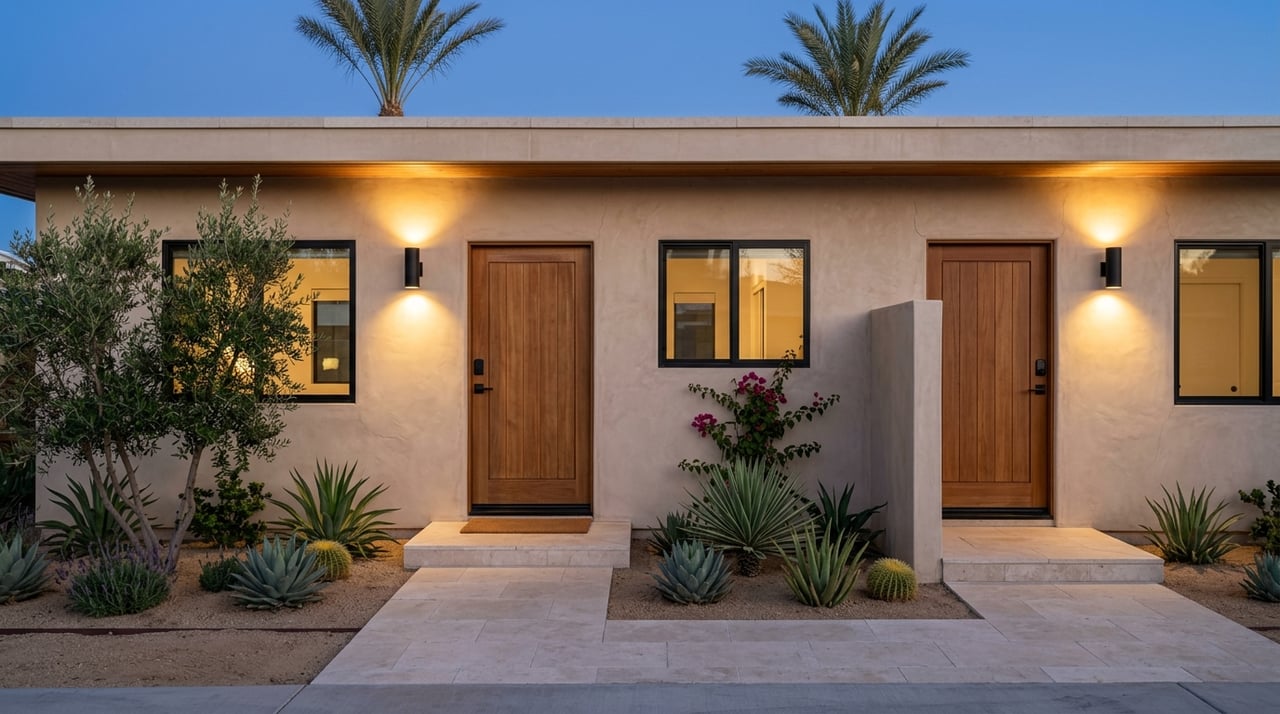
Indio Investment Properties Rentals: Short- and Long-Term
April 16, 2026
April 16, 2026
If you are thinking about buying an investment property in Indio, the biggest question is not just what to buy. It is how you plan to rent it. In a city shaped by winter visitors, major festivals, and year-round residents, your returns can look very different depending on whether you choose a short-term or long-term rental strategy. This guide will help you compare both paths, understand local rules, and spot the property features that fit each approach best. Let’s dive in.
Indio offers a mix of seasonal tourism and everyday housing demand that gets the attention of many buyers. According to the City of Indio demographics page, the city sees roughly 30,000 additional winter residents, and its festivals and special events attract more than 1.4 million visitors each year.
That matters because rental demand in Indio is not flat throughout the year. Some owners target peak-season revenue tied to festivals and winter travel, while others prefer the steadier rhythm of long-term leases. Your investment plan should match the way demand actually works in this market.
A short-term rental can be appealing if you want flexibility, higher peak pricing, and a property that may also serve as a second home. In Indio, though, the upside comes with more rules, more oversight, and more hands-on operations.
The City of Indio requires short-term residential rental owners to hold a business license, a short-term rental permit, and transient occupancy tax registration. The city’s current fee schedule lists the short-term residential rental permit at $1,730 for a new permit or renewal, not including business license or code compliance fees.
The city also states that you cannot rent or advertise a short-term rental without an active permit, and permits are not transferable to a new owner or parcel. You can review those requirements in the city’s short-term rental FAQs. If you are buying with an STR plan, this is important because a seller’s permit does not simply carry over after closing.
On top of permitting, short stays are subject to a 13% transient occupancy tax plus a 1% Greater Palm Springs Tourism Business Improvement District assessment on gross rental revenue for stays of 27 days or less. The city’s transient occupancy tax page also notes that operators must report and remit monthly, even if a booking platform collects some taxes.
Short-term rental success in Indio is about more than attractive photos and a nice pool. The city enforces quiet hours, occupancy standards, and complaint reporting, which means guest behavior can directly affect your investment experience.
Under the city’s STR rules, quiet hours begin at 9 p.m. Sunday through Thursday and 10 p.m. Friday and Saturday. During those hours, outside music and loud use of outdoor amenities are not allowed. The city also limits occupancy to two people per bedroom plus four, with daytime caps of 24 people on lots under 14,500 square feet and 40 people on larger lots, as outlined in the city’s short-term rental rules update.
Indio also maintains a 24/7 short-term rental complaint hotline and reporting process. For you, that means guest screening, parking management, and noise control are not optional. They are a core part of protecting income and reducing risk.
Indio has a sizable short-term rental market, but it is not a simple one. AirDNA’s Indio market overview shows about 2,910 short-term rentals, roughly 45% occupancy, an average daily rate near $617.60, and RevPAR around $259.30.
The same snapshot shows that 96% of listings are entire homes, with 4-bedroom homes and 5+ bedroom homes making up a large share of the inventory. It also shows that 31.5% of listings have 30+ night minimum stays, which suggests not every property is chasing weekend bookings. In practical terms, larger detached homes tend to fit the local STR model better than smaller, room-by-room setups.
If you want a simpler operating model, a long-term rental may be the better fit. You may give up some peak-season pricing, but you can gain steadier occupancy, fewer guest turnovers, and lighter administration.
For rentals of more than 30 days at a time, Indio requires a business license with annual renewal. The city’s business license information page states that homeowners renting property long term must obtain a business license, and the 2025 fee schedule lists the fee at $89 for a new long-term residential rental business license and $44 for annual renewal.
The city also notes that other departmental fees may apply, including building inspection, fire inspection, and planning review fees. So while long-term rentals are generally easier to manage from a city compliance standpoint, they are still part of a regulated business activity.
One of the most important things to understand in Indio is that rent data can vary depending on the source. RentCafe’s Indio rent trends report average apartment rent of $1,751, with 62% of rentals falling between $1,501 and $2,000 per month, while Zillow reports a broader rent index and shows higher figures.
That gap does not necessarily mean one number is wrong. It reflects different methodologies and housing mixes. RentCafe focuses on apartment buildings with 50 or more units, while broader indices can better reflect single-family homes and other property types. If you are evaluating a larger house, condo, or townhome, you will want to compare it to the right segment instead of relying on one broad average.
Indio’s planning framework supports a range of housing types and emphasizes stable residential areas near goods and services. The city’s planning materials also reference housing variety and second units on single-family residential lots.
That points many investors toward single-family homes, condos, townhomes, and ADU-style opportunities that work well for everyday living. In most cases, long-term rentals perform best when the home is easy to maintain, practical for year-round residents, and located with convenient access to shopping, commuting routes, and daily needs.
Both strategies can work in Indio, but they solve for different goals. A quick side-by-side comparison can help you decide which model better fits your budget, timeline, and tolerance for hands-on management.
| Factor | Short-Term Rental | Long-Term Rental |
|---|---|---|
| City compliance | Higher permit and tax burden | Simpler license structure |
| Upfront local fees | STR permit is $1,730, plus other applicable fees | New business license is $89 |
| Income pattern | Seasonal and event-driven | More consistent month to month |
| Management intensity | High | Moderate to lower |
| Best property fit | Larger detached homes with parking and outdoor space | Low-maintenance homes, condos, townhomes, ADUs |
| Vacancy risk | More sensitive to seasonality and competition | More tied to local household demand |
| Owner flexibility | May allow personal use between bookings | Usually limited during lease term |
Where you buy can shape your rental performance almost as much as the property itself. In Indio, the strongest fit often depends on whether your strategy is event-driven or resident-driven.
If your main goal is short-term rental income, proximity to the festival zone and major access routes matters. The Stagecoach site is located at Empire Polo Club, 81-800 Avenue 51, and the city’s 2026 festival traffic planning highlights key corridors such as Avenue 49, Avenue 50, Hjorth Street, Madison Street, Monroe Street, Jefferson Street, Washington Street, and nearby I-10 exits. You can see festival access details on the Stagecoach getting here page and timing for 2026 dates on the Coachella festival site.
This does not mean every nearby home is automatically a top STR candidate. It does mean that event access, parking, traffic flow, and guest logistics should play a major role in your underwriting for southern and event-adjacent parts of Indio.
If you prefer a long-term strategy, daily livability usually matters more than festival proximity. The city’s general plan materials point to stable neighborhoods, walkable settings, and housing choices near goods and services, while the city also highlights Downtown and the Highway 111 corridor in revitalization efforts.
For you, that means a long-term rental search should focus more on practical access and durable tenant appeal. A home that is convenient for everyday routines may be a better long-term performer than one chosen mainly for a few high-demand weekends.
The best Indio investment property is not always the one with the highest theoretical income. It is the one that fits your goals, budget, risk tolerance, and willingness to manage the moving parts.
You may lean toward a short-term rental if you want:
You may lean toward a long-term rental if you want:
It also helps to look at acquisition cost alongside income expectations. Zillow’s Indio home value data places the average home value at $517,774 as of March 31, 2026, so your numbers should account for financing, insurance, maintenance, utilities, vacancy assumptions, and local fees before you decide which model pencils out.
If you are weighing Indio investment properties and want a local perspective on location, property type, and rental strategy, Deborah Ferrell can help you compare options with a clear, practical approach tailored to your goals.
Stay up to date on the latest real estate trends.
Whether you're buying, selling, or investing in real estate, Terry and Deborah are here to assist you every step of the way. Contact us today to schedule a consultation and experience the difference our team can make for you!