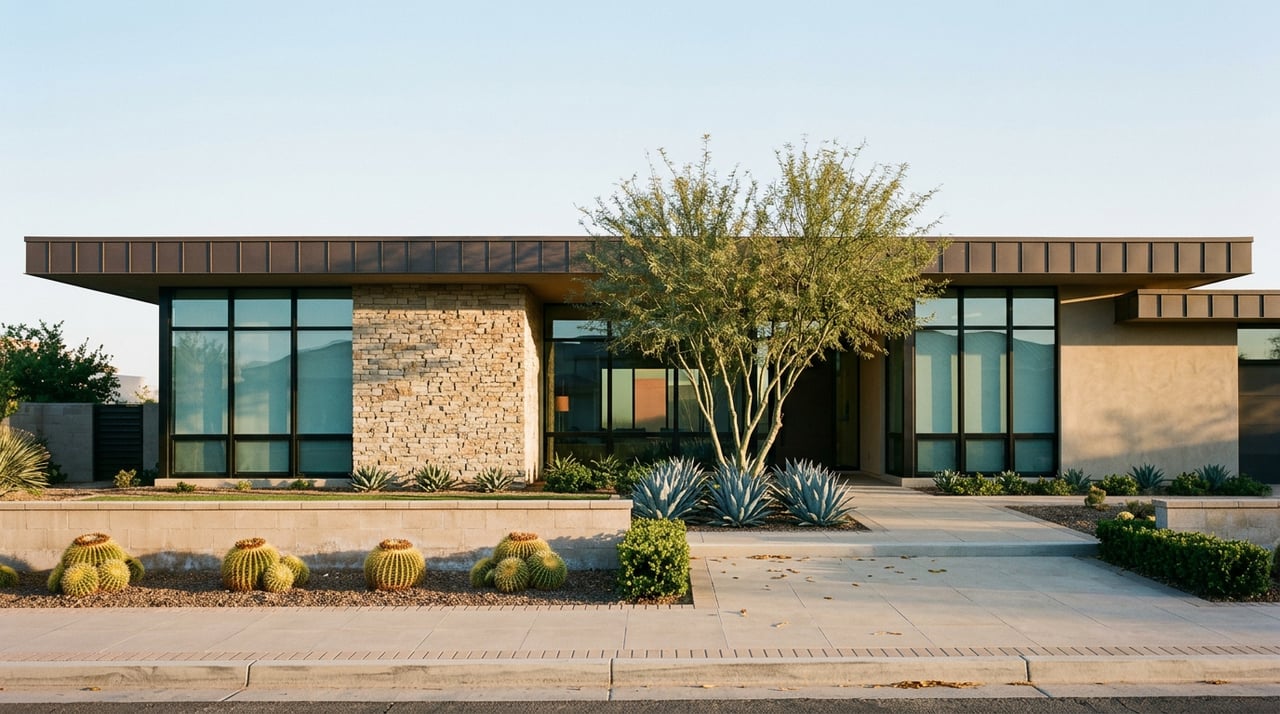
Why Every Website Quotes a Different Price for Homes in Indio
September 17, 2026
September 17, 2026
A seller in Central Indio lists her three-bedroom home this fall using the median price she pulled from a national portal. She prices it fairly, maybe even a little conservatively, and waits for offers. Meanwhile, fifteen minutes north on Jefferson Street, a buyer who toured her open house drives to a sales pavilion at Del Webb Desert Retreat and walks out with a rate locked well below a standard resale mortgage rate. The seller never lowered her price. She never had the chance to compete, because the competition wasn't another resale listing. It was a builder's financing desk.
This is the part the median price hides. Indio right now is not one housing market wearing a single zip code. It is two markets, new construction and resale, and depending on which one a data source happens to sample in a given month, the citywide number can swing by more than $100,000.
Pull up four different market trackers for Indio and you'll get four different pictures of the same city. Redfin's citywide figure for October 2025 put the median sale price at $534,000, down 4.3% year over year, with homes taking a median of 119 days to sell compared to 56 days the year before. Houzeo's read for July 2026 showed a median of $540,000, down 1.82% year over year, with a faster median of 64.5 days on market and a sale-to-list ratio of 97.86%, meaning sellers were routinely accepting under asking. Houzeo also noted that homes with price reductions climbed from 56.82% to 66.67% of listings, a sign of softening resale pricing power.
Then there's Orchard, whose most recent reported 30-day window showed a median of $650,000, up 21.5% year over year, built from just 10 closed sales compared to 21 in the same period a year earlier. Resideline's tracker, covering the six months ending in August 2026 across 692 closings, landed on a median of $520,000, with the middle half of all sales closing between $405,000 and $609,000.
| Source | Time window | Median price | Trend | Days on market |
|---|---|---|---|---|
| Redfin | October 2025 | $534,000 | down 4.3% YoY | 119, up from 56 |
| Houzeo | July 2026 | $540,000 | down 1.82% YoY | 64.5 |
| Orchard | trailing 30-day report, 2026 | $650,000 | up 21.5% YoY | 90, up from 14 |
| Resideline | six months through August 2026 | $520,000 | n/a (692 closings) | 52 (list to contract) |
Notice that Orchard's eye-catching 21.5% jump comes from only 10 transactions. A handful of new-construction closings at higher price points can pull a thin monthly sample far from where the broader resale market actually sits. That's not a data error. It's what happens when a city has an unusually active homebuilding pipeline running alongside its resale inventory, and any given 30-day window can land more heavily on one side or the other.
Indio has been one of the faster-growing cities on the east end of the Coachella Valley for several years, with new development reshaping downtown and the corridors along Highway 111 and Indio Boulevard, according to reporting from Palm Springs Life. That growth shows up most directly in North Indio, where a cluster of national builders is currently selling new homes within a few miles of each other, all competing for the same buyer.
Every one of these builders is offering some version of what Del Webb is offering: a financing incentive that functions like a hidden price cut. A rate buydown of even a point and a half can lower a buyer's monthly payment more than a resale seller could match by cutting their asking price by tens of thousands of dollars. Resale sellers rarely have the balance sheet to offer that kind of financing subsidy on their own.
If new construction is where the volatility lives, the more established resale neighborhoods tell a calmer story. Redfin's data for Central Indio, covering December 2025, showed a median sale price of $483,000, up 19.1% year over year, with a median price per square foot of $313, itself up 7.4%. Homes there sold in a median of 68 days, actually faster than the 76 days recorded the year before.
That's a meaningfully different trend line than the citywide swings above. Central Indio's resale stock isn't competing against a builder's finance desk in the same block. It's an older, more established part of the city where buyers are comparing one existing home to another, and price per square foot has room to climb in a way that isn't distorted by a wave of new supply hitting the market at once.
The lesson isn't that one part of Indio is a better place to own. It's that the citywide median blends two products that behave differently, and a buyer or seller who only looks at the blended number is missing the part of the story that actually applies to their transaction.
If you're selling a resale home in Indio right now, your real competition may not be the house down the street. It may be a builder's sales office offering a rate buydown that changes a buyer's monthly math more than your price ever could. Knowing which new-construction communities are active near your listing, and roughly what incentives they're running, tells you more about your true competitive set than the citywide median does.
If you're buying, the opposite caution applies. A new-construction home with a builder-subsidized rate can look like the better deal on a monthly payment basis, but that rate structure, like Del Webb's 7/6 ARM, typically resets after an introductory period. Comparing a resale home's fixed-rate payment against a new-build's introductory payment isn't quite comparing like to like, and it's worth running both scenarios past your lender before deciding which number actually represents your long-term cost.
Why do different websites show such different median home prices for Indio? Because each tracker samples a different slice of the market during a different window, and Indio's active new-construction pipeline means the mix between new-build and resale closings can shift sharply from one month to the next. A 30-day sample with only a handful of transactions, like Orchard's recent 10-sale window, will look very different from a six-month sample of nearly 700 closings.
Are builder incentives actually better than a lower resale price? It depends on how long you plan to hold the loan and what the rate looks like after any introductory period ends. A buydown can meaningfully lower your payment in the early years, but it's worth comparing the total cost against a resale home financed at a standard fixed rate before deciding.
Is Central Indio a different market than North Indio? They're both part of the same city, but they're behaving differently right now. North Indio has the bulk of the new-construction activity and the pricing swings that come with it. Central Indio's resale market has shown steadier, more gradual movement.
Numbers like these change by the month, and the mix of new construction and resale inventory near any specific address matters more than the citywide average. If you're trying to figure out what's actually happening on your street, whether you're selling a resale home or comparing it against a new-build a few miles away, Homes in the Desert can walk through the current inventory with you. Schedule a Free Consultation and get a read on your specific part of Indio, not just the blended number.
This article is general information, not legal, tax or financial advice. Consult a qualified professional about your situation.
Stay up to date on the latest real estate trends.
Whether you're buying, selling, or investing in real estate, Terry and Deborah are here to assist you every step of the way. Contact us today to schedule a consultation and experience the difference our team can make for you!